Adam Zachary Wasserman
Author and researcher: philosophy of science, artificial intelligence, and the metaphysics of complex emergent structure.
Kansas City, MO
The work, in plain terms
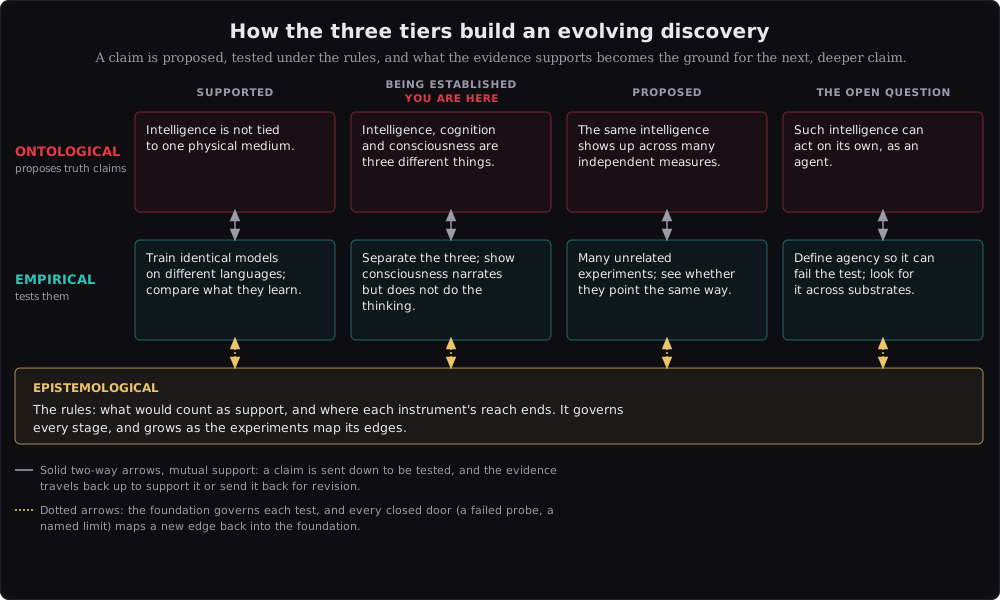
I study what intelligence, cognition, and consciousness actually are, beginning from the suspicion that we routinely confuse the three.
My method is plain. I measure. I write my predictions down before I run the test, so I cannot move the goalposts afterward, and I build each conclusion as a chain anyone can trace and check. I treat every instrument of knowing, including science itself, as a lamp with a limited beam: trustworthy inside its circle of light, and obliged to admit where that circle ends.
Inside that discipline, three claims take shape.
Intelligence is structure, and structure belongs to no single physical medium. A language shows this plainly: the same language lives in a brain, on paper, on a screen, or in the air as sound, and stays itself in each. Intelligence, I argue, is structure of that kind, able to exist on more than one physical medium, whether neural tissue, a computer, or a strand of DNA, rather than being the property of any one. This can be demonstrated, not merely asserted.
Cognition is the physical machinery that reads and runs that structure. It is firmly bound to its material.
Consciousness is smaller than it advertises. It narrates our lives and takes credit for the thinking, but it is not where the intelligence lives. Returning it to its real and modest role is part of the work.
The question I am building toward is whether intelligence of this kind can be genuinely self-directed: an agent rather than a mechanism. I do not claim the answer. I claim that the question is legitimate, and that ruling it out in advance, on the grounds that physics must already explain everything, is itself an article of faith.
I would rather measure than assume.
The method, in one word
A single discipline runs under both halves of the work, and it proceeds by negation. In the research, by falsification: ruling out false explanations and naming where each instrument stops seeing. In the software, by construction: eliminating entire classes of error by making them impossible to build. Knowledge by ruling out, correctness by ruling out. It is, in the old word for knowing by negation, apophatic.
Research
One point of view runs through all of it: every scientific instrument has limits, and asking what an instrument can and cannot adjudicate is the step everything downstream rests on. The Robot in the Dark sets out the position. The cross-linguistic experiments test it. Honest Code and the Open Honest audit apply it to enterprise software. The Replicators is the synthesis.
Four pre-registered deposits are in place, a child-scale extension has been accepted for peer-reviewed presentation, and a geometric-loss extension is in pre-registration. Collaborators: David Beauchemin (Laval), Hafedh Mili (UQAM), Edward Levin (VM4AI).
→ The full research program, with OSF pre-registration IDs, Zenodo DOIs, replication packages and training logs.
→ Findings, shorter measurements with their caveats attached.
Books
The Replicators (in preparation)
Outline complete; sample chapters drawn from the Weinstein vs. Dawkins three-part Substack series (2022).
Honest Code (commercially published)
Sixteen principles for eliminating hidden state in software. Side-by-side comparisons in twelve programming languages with real nanosecond execution traces.
The Chaos Factory (2017)
The inside story of corporate IT failure. Favorably reviewed by Bloor Research.
ADHD Meets AI (2026)
The honest book about restless brains and artificial intelligence, written by someone who builds AI for a living and has lived the restless brain his whole life: what the machine genuinely does for a mind wired for synthesis at untrackable speeds, and where it will quietly hurt you. Subtitle: How Restless Brains Are Using Artificial Intelligence to Unlock Super Productivity.
Writing
- Essential Musings Substack archive, 40+ essays since 2022 working through the philosophical and empirical questions the books bring together. Includes the foundational Weinstein vs. Dawkins three-part series (May 2022) that introduces the Replicators thesis.
- Hackernoon Technology articles
- Welcome to the Jungle Enterprise technology and careers
- Hacker News Historical and conceptual commentary
Talks and interviews
Abstraction Layers, in conversation with Jack Couch
A long-form interview on the Language-Only Hypothesis: why large language models reveal structure already deposited in language rather than generating intelligence from scale, and what follows for how we read what today's AI can and cannot do.
Open source
DATAOS ecosystem
DATAOS (DOM As The Authority On State) is the operational philosophy underlying the Honest Code book. Its premise is that the DOM, treated as the single authoritative source of application state, eliminates the need for state-management libraries entirely. The multicardz application (~140K lines of production code) is a working operational demonstration of distributed-collaborative-intelligence design principles in a 4E-cognition-compatible system.
| Project | Description |
|---|---|
| DATAOS | Architecture: DOM as the single source of state |
| domx | DOM state observer, under 1KB, zero dependencies |
| genX | Declarative behavior via HTML attributes, under 1KB |
| stateless | React hook that reads state from DOM instead of useState |
Open Honest
Open Honest is the empirical and operational research program built around the Honest Code principles: a correct-by-construction development framework whose limits are bounded by architecture rather than by hope, and a peer-reviewable measurement instrument for enterprise software quality whose own thresholds are explicit and falsifiable. Eight pre-registered studies (Papers A through H) sit alongside the working code.
| Project | Description |
|---|---|
| Honest framework | Correct-by-construction development framework with multi-language analyzer, four-language tree-sitter detector, and a 276-scenario behavioural specification |
| Honest audit | Four-layer measurement instrument for enterprise software quality; explicit indicator thresholds; instrument edges named |
| Honest Code Principles | Twenty-three principles the framework and the audit both implement, published as one file a project can depend on instead of copying |
Other professional work
Buckler AI
AI compliance for regulated markets. Developed the ClearSignal methodology for compliance attestation. Fractional CTO.
Sizzl
Fractional CTO consultancy for enterprise technology.
multicardz
Next-generation kanban: add rows, change the criteria used to build rows and columns on demand, and handle sets of over 1 million cards in under 1 second.
Background
Forty years of operational practice in enterprise software in regulated industries. CTO of the International Air Transport Association (IATA, the multinational NGO that operates global air-travel standards and the industry's settlement systems). Director of Consulting at CGI, one of approximately 600 directors carrying full profit-and-loss accountability across CGI's global consulting practice, leading the telecoms and health sectors. Senior technical-leadership roles at Bombardier and Yellow Pages.
The 2017 publication of The Chaos Factory began a deliberate pivot from operational leadership into contributing to the body of knowledge. The unifying through-line across the writing since then: distributed multi-agent collaboration across substrates and time is the better explanation for complex emergent structure than either reductionist randomness or singular design.
Self-taught. No formal degree. Built one of the first production web applications in 1996 for the Employee Relocation Council. The work is the credential.